The short version
- Link age stability (Do links stick around?)
- Publisher consistency (How often do they publish?)
- Social engagement (Do people share their content?)
On this page11 sections
- Why Backlinks Still Matter (Despite What You Might Have Heard)
- What's This API Thing All About?
- A caveat on the data any API returns
- Real Benefits I've Seen After Implementing Backlinks API
- Caught a Negative SEO Attack Within Hours
- Discovered Link Building Opportunities Others Missed
- Finally Connected Content Performance to Link Acquisition
- Automated the Boring Stuff
- How Savvy Teams Are Using Backlinks APIs
- Building Competitive Intelligence Systems
- Creating Custom Link Quality Scores
- Integrating with Content Management Systems
- Tracking Anchor Text Shifts
- Challenges You'll Face When Implementing
- Rate Limiting Headaches
- Data Standardization Issues
- Historical Data Limitations
- Step-by-Step: Getting Started with Backlinks API Integration
- Real Talk: Is This Worth the Effort?
- Wrapping up
- FAQs
- Related Tools & Guides
I've spent years wrestling with backlink analysis tools. Remember when we'd export CSV files and manually compare them? Those late nights staring at spreadsheets, trying to spot patterns? That's why I nearly jumped out of my chair when I first connected to a proper Backlinks API. Major win doesn't begin to describe it.
Why Backlinks Still Matter (Despite What You Might Have Heard)
Let's cut through the noise: backlinks remain crucial ranking signals. Google's John Mueller confirmed this again just last quarter. My clients in competitive niches like finance and legal have seen this firsthand - their rankings consistently correlate with quality backlink growth.
But here's the thing - backlink analysis shouldn't be a monthly ritual. The web moves too fast. By the time you've downloaded your report, your competitors have already secured three new authoritative links.
What's This API Thing All About?
Think of a Backlinks API as having a direct line to a massive backlink database. Instead of logging into a dashboard, waiting for reports to generate, and then downloading them, you're getting fresh data delivered exactly where and when you need it.
The technical definition? It's a programmatic interface that lets your tools communicate directly with backlink databases. The practical definition? It's what lets you stop wasting time on manual lookups and start making decisions based on real-time data.
A caveat on the data any API returns
Before you build workflows on top of a backlinks API, keep in mind that the underlying data is a crawl-based estimate, not ground truth. Experienced SEOs are blunt about the gap. As one put it in an r/SEO thread:
"the data never seems accurate compared to what I see in GSC or GA. Not worth the cost to me anymore." (u/landofcheeseandhoney, r/SEO)
That is not a reason to skip the API, it is a reason to use it well: treat its counts as directional, and reconcile anything that drives a real decision against Google Search Console for your own domain. With that caveat, the benefits below are genuinely useful.
Real Benefits I've Seen After Implementing Backlinks API
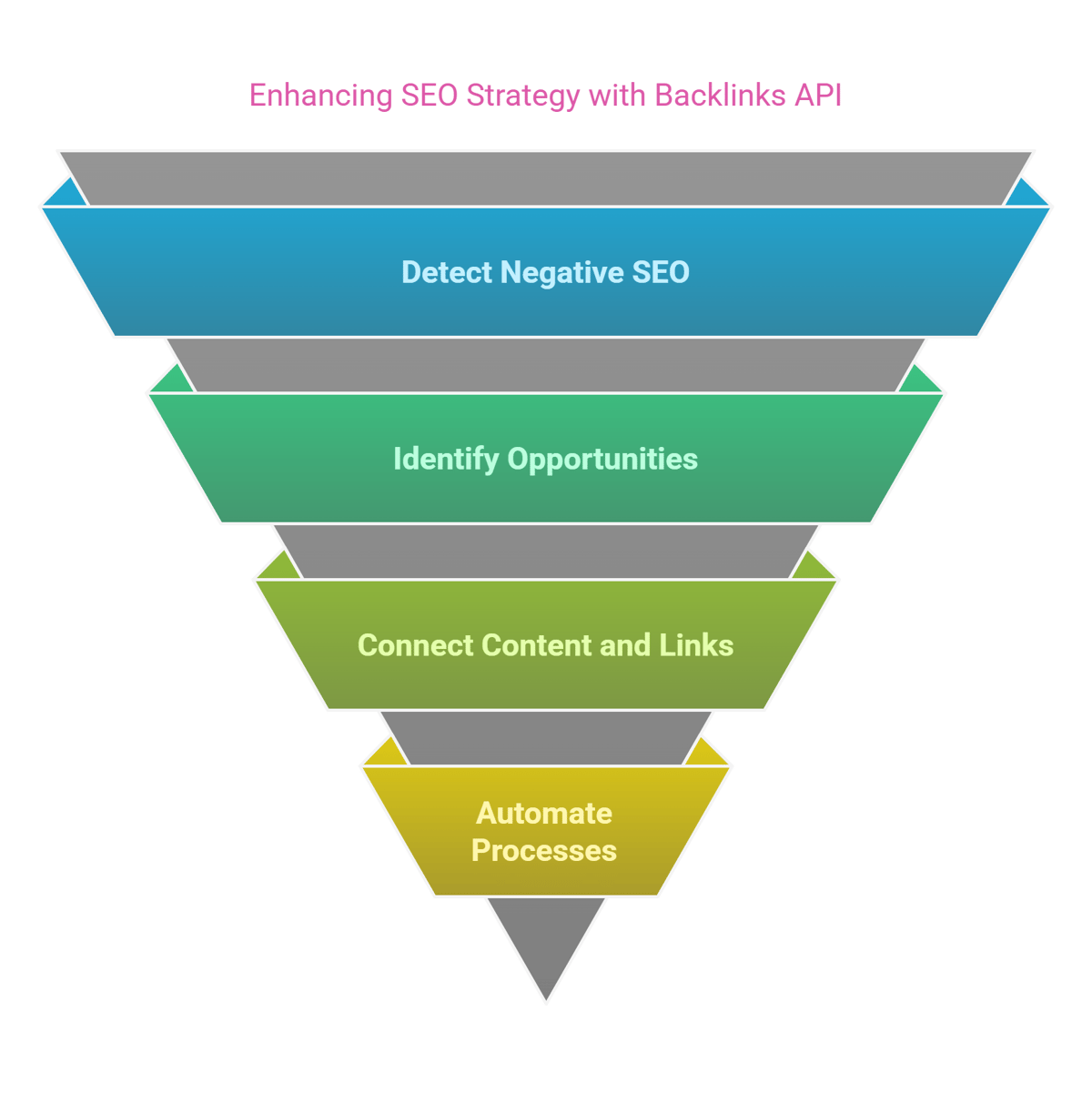
Caught a Negative SEO Attack Within Hours
Last year, one of my e-commerce clients suddenly gained 500+ suspicious links overnight. Because we had API alerts set up, we spotted the pattern immediately and submitted a disavow file before any ranking damage occurred.
Discovered Link Building Opportunities Others Missed
By tracking competitor backlinks daily (not monthly), we identified a series of industry roundups that were actively adding new resources. We reached out while these pages were still being updated - something impossible with traditional periodic analysis.
Finally Connected Content Performance to Link Acquisition
We built a dashboard that overlays content publishing dates with natural backlink acquisition. This revealed that our detailed case studies earned 3x more organic links than our how-to guides. We adjusted our content calendar accordingly.
Automated the Boring Stuff
No more manual link quality assessments. Our system now flags new links by quality tiers based on our custom criteria. Only the most promising or concerning links get human attention.
How Savvy Teams Are Using Backlinks APIs
Building Competitive Intelligence Systems
A marketing agency I consult with built what they call their "Backlink Radar." It monitors 15 competitors across 5 client industries. When it detects multiple competitors gaining links from the same domain, it flags that source as a high-priority outreach target.
Creating Custom Link Quality Scores
Traffic estimation tools are notoriously inaccurate. A SaaS company I work with instead built a composite score that weighs:
- Link age stability (Do links stick around?)
- Publisher consistency (How often do they publish?)
- Social engagement (Do people share their content?)
This custom formula has proven far more predictive of a link's value than off-the-shelf metrics.
Integrating with Content Management Systems
One publisher integrated their Backlinks API with their CMS so authors can see which external sites have linked to their previous articles. This helps writers nurture relationships with publications that already appreciate their content.
Tracking Anchor Text Shifts
A finance site built an alert system that flags changes in anchor text patterns, helping them stay ahead of potential over-optimization penalties.
Challenges You'll Face When Implementing
I won't sugarcoat it - working with APIs requires some technical chops. Most implementations hit a few roadblocks:
Rate Limiting Headaches
Most providers restrict how many calls you can make. Your developer will need to implement smart caching and batching to avoid hitting these limits.
Data Standardization Issues
Different tools define metrics differently. Domain Authority from one provider isn't the same as Domain Rating from another. You'll need to standardize these into your own consistent scoring system.
Historical Data Limitations
Many APIs only provide current data without historical context. This means you should start archiving your own results from day one.
Step-by-Step: Getting Started with Backlinks API Integration
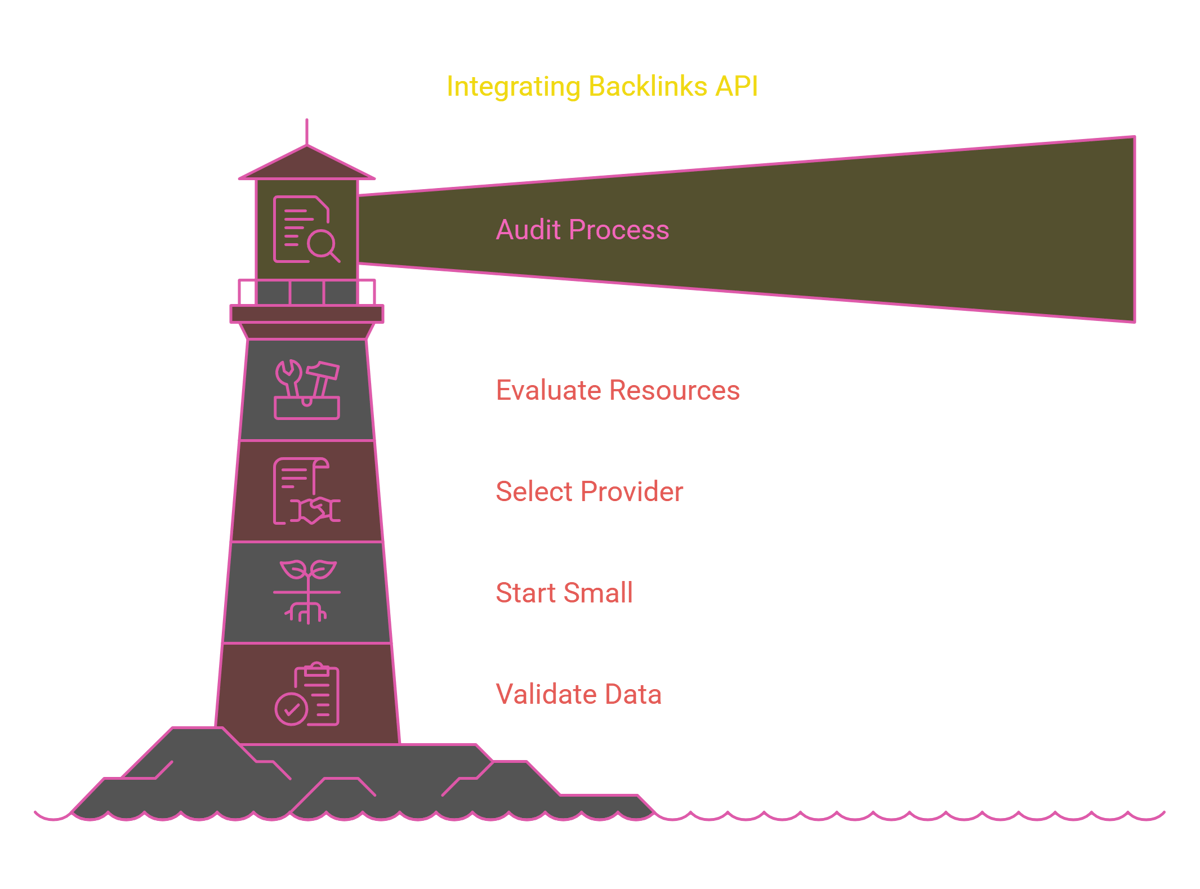
- Audit Your Current Process What backlink questions are you answering manually today? Document these specific use cases before looking at API solutions.
- Evaluate Technical Resources Do you have development help? If not, consider middleware solutions that can connect APIs to your existing tools with minimal coding.
- Select the Right Provider Beyond data quality, evaluate documentation quality and support resources. The best data is useless if your team can't implement it.
- Start Small Begin with a single high-value use case. Monitor new backlinks to your most important pages, for example, before building complex competitor analysis systems.
- Validate Data Quality Cross-check API results against manual research for your first few weeks. APIs sometimes miss links that traditional crawlers find.
Real Talk: Is This Worth the Effort?
For some businesses, frankly, no. If you're in a low-competition niche with stable rankings, the investment might outweigh the benefits.
But if you're in a competitive space where backlinks directly impact revenue, connecting to a Backlinks API isn't just worth it - it's necessary to stay competitive.
The marketing team at a mid-sized B2B company I advised calculated that their API implementation saved 15 hours of manual work weekly while identifying link opportunities worth an estimated $25,000 in equivalent PPC costs.
Wrapping up
The backlink terrain gets more complex every year. Manual analysis just can't keep pace. Whether you're fighting off negative SEO, looking for untapped link opportunities, or trying to understand why competitors are suddenly outranking you, having direct access to backlink data through an API gives you the speed and insight needed to stay ahead.
Remember, it's not about having more data - it's about having the right data at the right time, precisely when you need to make decisions. That's the real power of unlocking backlink insights through API integration.
FAQs
-
Isn't this overkill for small businesses?
It depends on your competition. One local business I work with only monitors backlinks to their five target keywords, which is simple enough to implement even with limited resources.
-
How much technical expertise do I really need?
While deep API integration requires development skills, several marketing platforms now offer "no-code" connections to popular backlink APIs. These provide basic functionality without custom development.
-
What should I monitor first?
Start with tracking new backlinks to your most valuable pages. This simple alert system delivers immediate value while you develop more sophisticated analyses.
-
Will this replace my current backlink tools?
Not entirely. Think of API access as complementing your existing tools by adding automation and real-time monitoring to your current analysis processes.
-
How do I justify this investment to leadership?
Calculate the hours currently spent on manual backlink analysis. Then estimate the value of catching problems earlier or identifying opportunities faster. The ROI becomes clear when presented this way.
Related Tools & Guides
Want these links without the spreadsheet?
We submit your product to 100+ directories by hand, starting at $99. Or the agent finds and pitches the pages already ranking for your keywords for $99 a month. Either way, you see every link before it goes live.