Online Directory Listings: Are They Still Relevant for SEO?

To many marketers, the notion of using online directory listings is somehow connected with the forgettable era of the digital space, when it was believed that the more links, the higher the position on the search engine. The businesses used to submit their information to hundreds of directories, expecting that this would increase their sales and authority on the search engine. Although the technique was effective in the past, the rules of the SEO game have dramatically altered.
Search engines such as Google have moved beyond just backlink counting. Nowadays, the priority goes to the quality, relevance, and meaning of those links. The question is now, are directory listings still a thing for SEO in 2025 or have they become just digital clutter?
Understanding Google's Changing Perspective
Google no longer assesses backlinks equally. Listings from low-quality, generic directories are now tagged as spammy and can essentially trigger a decrease in your rankings. Trust signals are favoured by the algorithm, and these come from credible, well-cared-for sources.
Instead of being included in a mass listing, Google is no longer the beneficiary of the inaccurate, untrustworthy listing on the business directory sites, but it is still a trusted advertising option among high-authority platforms that should be used. The local SEO field also benefits significantly from the active participation of established business directories, which, along with other benefits, help in building trust and improving visibility.
Why Quality Beats Quantity Today
The era of slapping your business on 200+ directories is gone. By 2025, the significant factor is whether a directory is relevant to the niche, recognised as credible, and visited by real users. A link from a trusted website, such as Clutch or G2, has much more significance than several links from generic websites.
These quality listings additionally foster referral traffic and credibility. Users come across your brand on dependable platforms, which hang on the name of your brand itself, and Google is not blind to that kind of behaviour.
Where Directory Listings Still Make a Difference
Directory listings are most effective for local businesses. Sites such as Google Business Profile, Yelp, and Apple Maps are must-haves for mapping and "near me" search rankings. These platforms directly affect what customers see in local searches.
Niche business directories can be helpful even to international firms. A listing on ProductHunt or Crunchbase can be an excellent tool for establishing authority in the industry and also accumulating valuable backlinks, especially when combined with user reviews or product updates.
Niche directories and curated marketplaces are the most effective in the current SEO game. For instance, OTPApps.com not only lists products but also serves perfectly to the market of people wanting lifetime software deals. These kinds of curated directories are the means of acquiring quality traffic and backlinking from sites that are more credible than simple directories that have low traffic.
What to Watch Out for in 2025
Submitting to low-quality directories that accept every listing can lead to penalties. Such sites commonly have little editorial control, thus becoming targets for spam filters. Keep away from anything that comes across as obsolete or unconnected to your trade.
A different blunder? Letting your listings age. In the long run, a wrong contact address, a broken link, or the absence of reviews can cause distrust. Check-ups are a must to maintain the health of your directory strategy.
Comparison: Old vs. Modern Directory Strategies
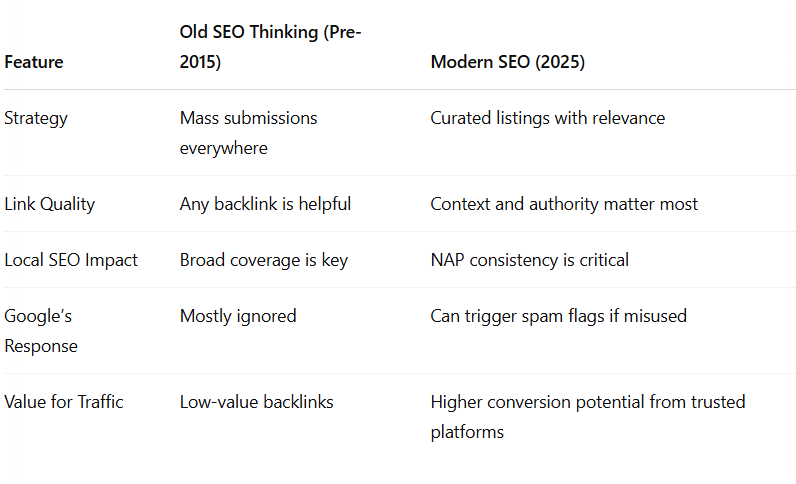
Tracking the effectiveness of directory submissions is not easy on all occasions. A number of platforms give convincing analytics, while others just do not show much. Attaching UTM tags in your directory links gives the ability to trace the referral traffic being generated in Google Analytics.
Another alternative is to use different phone numbers, or landing pages, to each other listing. That way, the marketers can track which directories send the qualified leads and what they should check or update.
How Directory Listings Fit into Modern SEO
Directories alone will not get your site to the top position, but they still form a

part of the larger SEO ecosystem. Sending signals of trust, they sustain your online identity and enhance Google's perception of the relevance of your business.
Instead of seeing them as growth tactics, look at them as basic building blocks. As the basics are ready—NAP consistency, updated links, and quality sources—you can add to that with stronger backlink campaigns and content strategies.
Instead of chasing outdated listings, platforms like OTPApps.com provide lasting SEO value. They combine curated exposure with strong referral intent, helping software creators and startups boost discoverability while reinforcing brand trust.
Conclusion
Directory listings haven't decreased in effectiveness; they have simply been upgraded. It is no longer a matter of volume or tricks. Instead, in 2025, they are about accuracy, relevance, and brand visibility on the web. The topic is especially relevant for marketers working on local or niche SEO, who should still consider good directory listings as their well-directed energy.
If you have recently missed viewing your listings, this is the right moment. Clear any spammy stuff, correct the wrong data, and focus your efforts on the ones that generate actual value. Rightly done, the directory listings play a substantial part in the trust-based SEO space where we all exist and operate today.
FAQs
Are online directory listings still useful for SEO?
Sure, online directory listings are still relevant for SEO, especially for local businesses. They not only enhance online visibility but also provide valuable backlinks to the site, in addition to helping search engines to verify the business information, therefore, increasing the quality of the local search results.
Are directory listings good for local SEO?
Indeed. Directory listings are very important for local SEO. With NAC (Name, Address, and Phone Number) being correct and consistent across a variety of platforms, it improves search engine ranking and visibility for local businesses.
What is the effect of online directories on a website's SEO performance?
User directories operate by bringing searchers to their viewer sites, which in turn brings up the business's online presence. Being registered on the most recognised databases, businesses might see a rise in placement results on search engines, as well as acquiring more trust from both users and search engines.
What advantages does listing in online directories give?
Joining online directories has several advantages: increased online exposure, better local search results, an increase in website visitors, and the building of credibility with consumers via coherent business details on several platforms.